How a three-card tarot spread works
One card gives you a theme for the day. Three cards give you a small story, with a beginning, a turn and a difficulty, and that is usually enough to think with. It is the spread most readers learn first and keep using.
Why three
A single card can only say one thing. Ten cards, as in the traditional Celtic Cross, can say a great deal, but the reading takes time and the cards start to blur together. Three is the smallest number where the cards can talk to each other: two can agree with the third, or one can pull against the other two.
Common layouts
The cards are laid in a row and each place in the row is given a meaning before any card is turned. Different readers use different meanings. The best known are these:
- Past, present, future: how you got here, where you are, where things are heading if nothing changes
- Situation, action, outcome: what is going on, what you could do, what that might lead to
- You, the other person, the relationship: for a question about two people
- Mind, body, spirit: a check-in across three areas of life
The spread used on this site
Every daily reading here uses three places: where it starts, what it asks of you, and what stands in the way. The first card is the situation you begin the day in. The second is the thing being asked of you, the move or the attitude the day calls for. The third is the obstacle, often something in you rather than out in the world.
There is deliberately no "future" card. A reading that tells you what is coming invites you to wait for it, while a reading that names what is being asked and what is in the way gives you something to do.
Reading the three together
Read each card on its own first, then read the row as one sentence. A few things are worth noticing. If two or three cards share a suit, the reading is centred in that area of life: Cups for feelings, Pentacles for work and money, Swords for thoughts and arguments, Wands for drive. If most of the cards are major arcana, the day is touching something larger than routine.
Look at the figures as well. A person who faces towards the next card seems to be moving on; a person who faces away seems to be leaving something behind. And look for contradiction: a hopeful card blocked by a cautious one says more than three cards that agree.
A worked example
Suppose the cards are the Eight of Cups, the Page of Wands and the Four of Pentacles.
Where it starts: the Eight of Cups shows a figure in red walking away at night from eight cups stacked neatly behind him. Something that took real effort to build no longer satisfies, and part of you has already left.
What it asks of you: the Page of Wands is a young messenger in a bare desert, looking at a living branch. The card asks for curiosity and a first small move towards something new: a message sent, a class signed up for, an idea tried out.
What stands in the way: the Four of Pentacles is a man holding one coin to his chest, with another balanced on his crown and two pinned under his feet. He is safe and stuck. The obstacle is holding on to what is known because letting go of it is frightening.
Read together: you are ready to move on, the day asks you to take one curious step, and the thing stopping you is the grip you still have on the familiar. No card here predicts an outcome. Together they describe a choice.
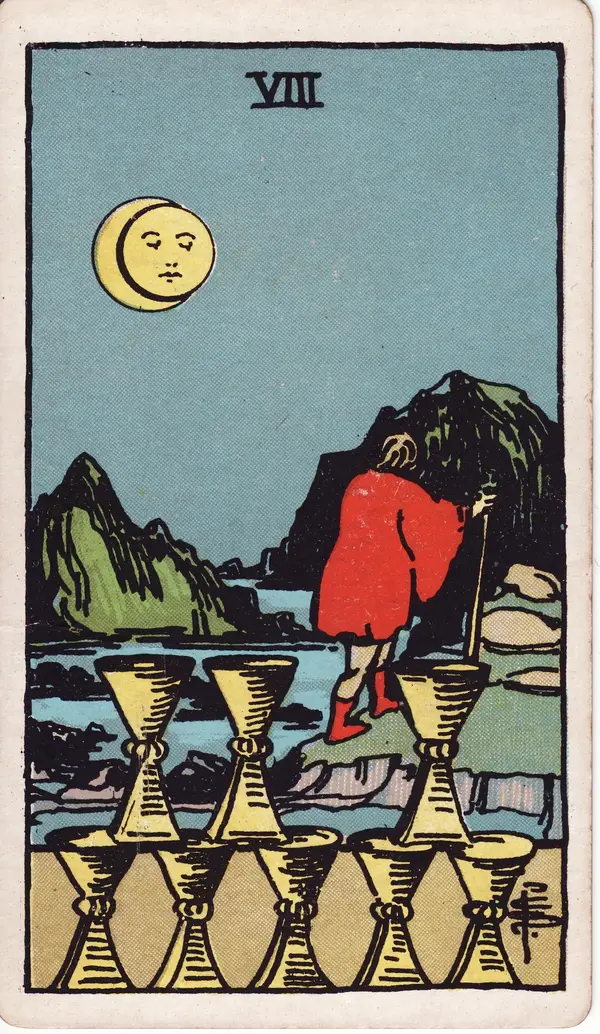
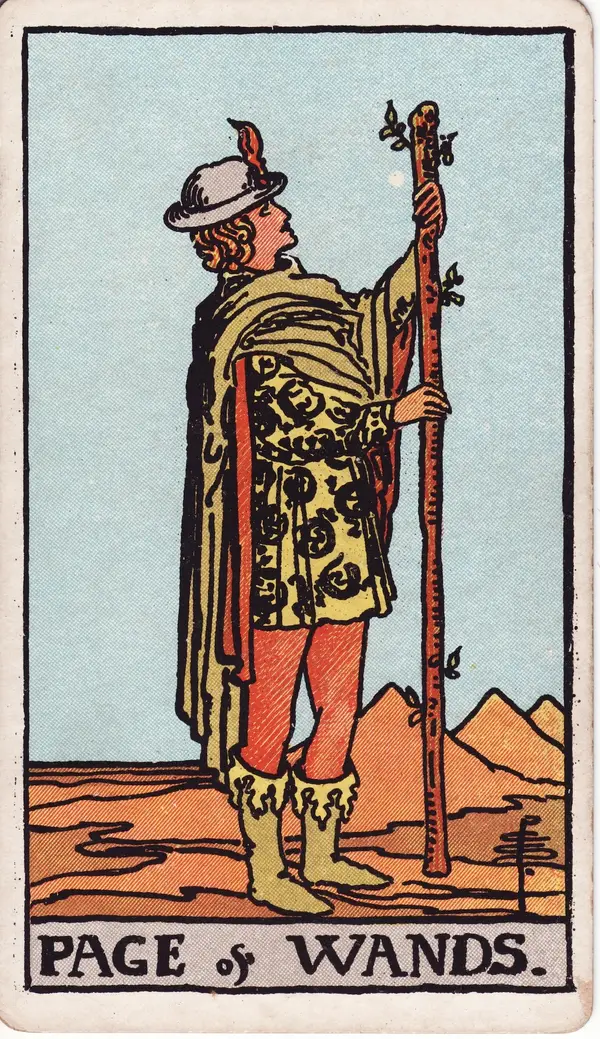
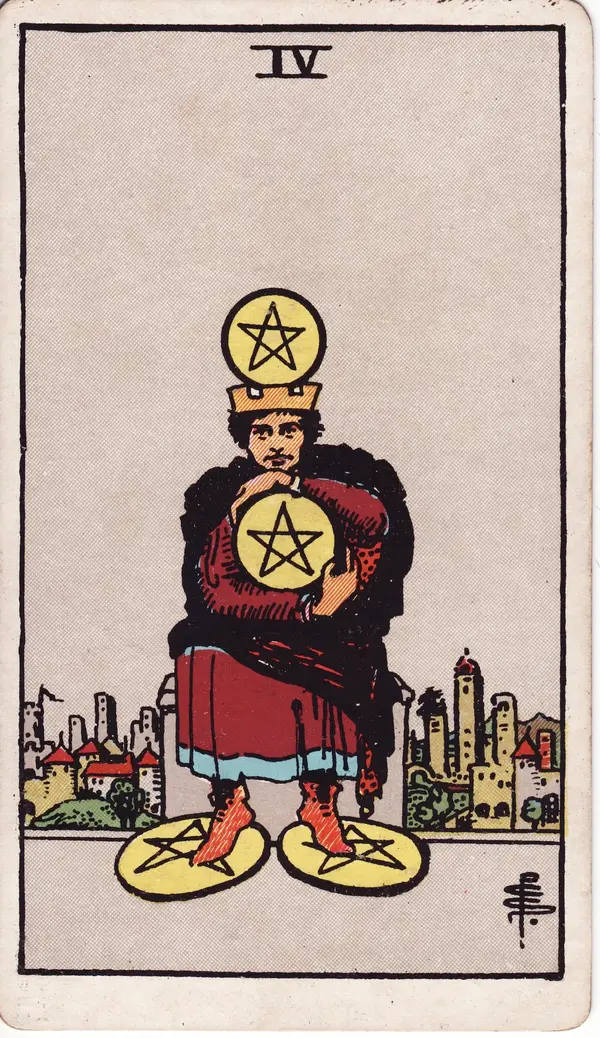
Where it starts, what it asks of you, what stands in the way.
See which three cards come up for you today, read for your star sign and the moon.
Get today’s readingRider–Waite–Smith, 1909 · art by Pamela Colman Smith