A short history of tarot
Tarot did not begin as fortune-telling. For more than three hundred years it was a card game, and the pictures people study today were made to be played with, bet on and admired.
A game at the Italian courts
Playing cards reached Italy in the late 1300s, most likely by way of the Islamic world, with four suits that are still recognisable: cups, coins, swords and batons. Early in the next century somebody in northern Italy added a fifth series of picture cards that outranked every suit. They were called trionfi, triumphs, and the word survives in English as "trumps".
The earliest written record is an account book from the court of Ferrara in 1442, which pays for packs of trionfi cards. The game they were made for, later called tarocchi, is a trick-taking game, and it never died out. Tarot is still a popular card game in France, and its cousins are played across Austria and central Europe with packs that have nothing mystical about them.
The Visconti-Sforza cards
The oldest tarot cards that survive were painted in Milan in the middle of the fifteenth century for the ruling Visconti and Sforza families. They are luxury objects, painted by hand on gold leaf, and the work is usually attributed to the painter Bonifacio Bembo. About fifteen of these decks are known, and not one of them is complete.
Many of the trumps are already familiar: the Emperor, the Lovers, Death, the Wheel of Fortune, the Sun. Others look very different from the cards on this site. The Milanese Strength is a man raising a club over a lion, a picture of force, where the 1909 card shows a woman closing a lion's mouth with her bare hands. The idea of strength moved from beating something to calming it.
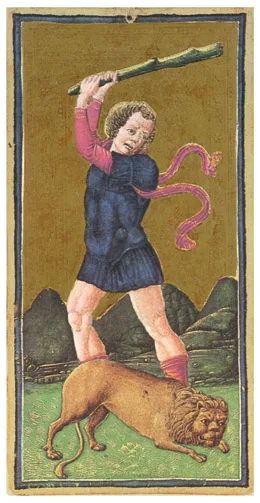
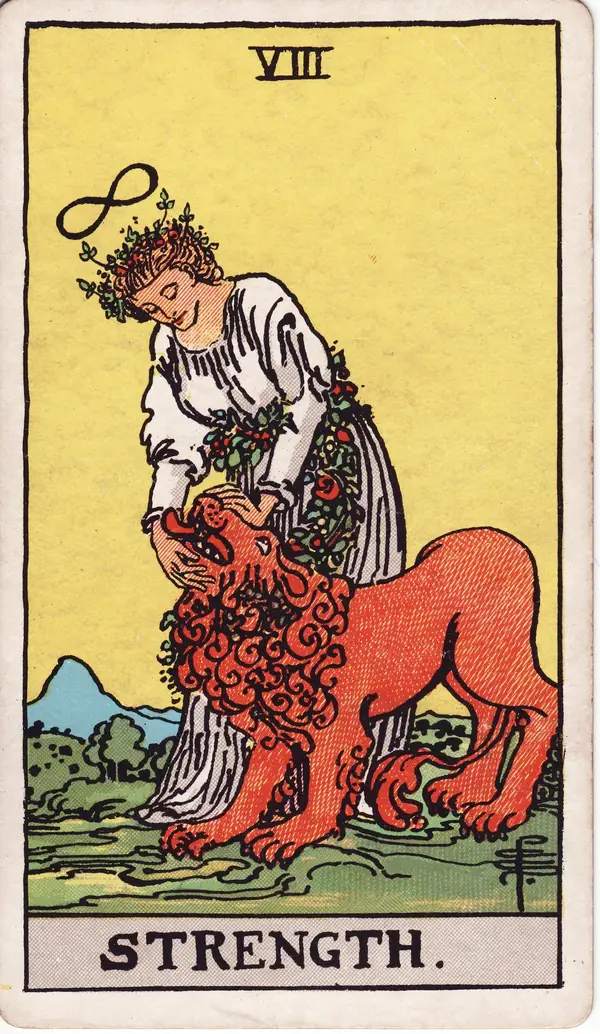
Strength around 1450 and in 1909.
Strength: Visconti-Sforza tarot, Milan, mid-15th century, attributed to Bonifacio Bembo. Public domain, via Wikimedia Commons.

The Tarot of Marseille
In the 1600s and 1700s, printers in France turned out tarot packs from carved woodblocks, coloured through stencils. One design became the standard, now called the Tarot of Marseille after the city where many of the later packs were made. It fixed the order of the trumps and the look of each one for the next two centuries.
The pack by Jean Dodal of Lyon, printed in the first years of the 1700s, is a good example. Its first trump is Le Bateleur, a street performer doing tricks at a table. Two hundred years later the same figure is the Magician, still standing behind a table, now laid out with the four symbols of the suits.
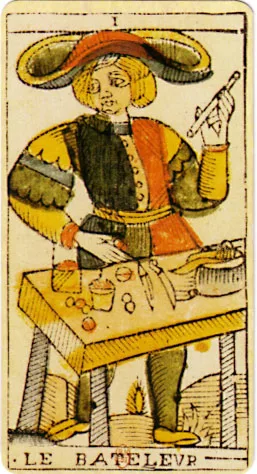
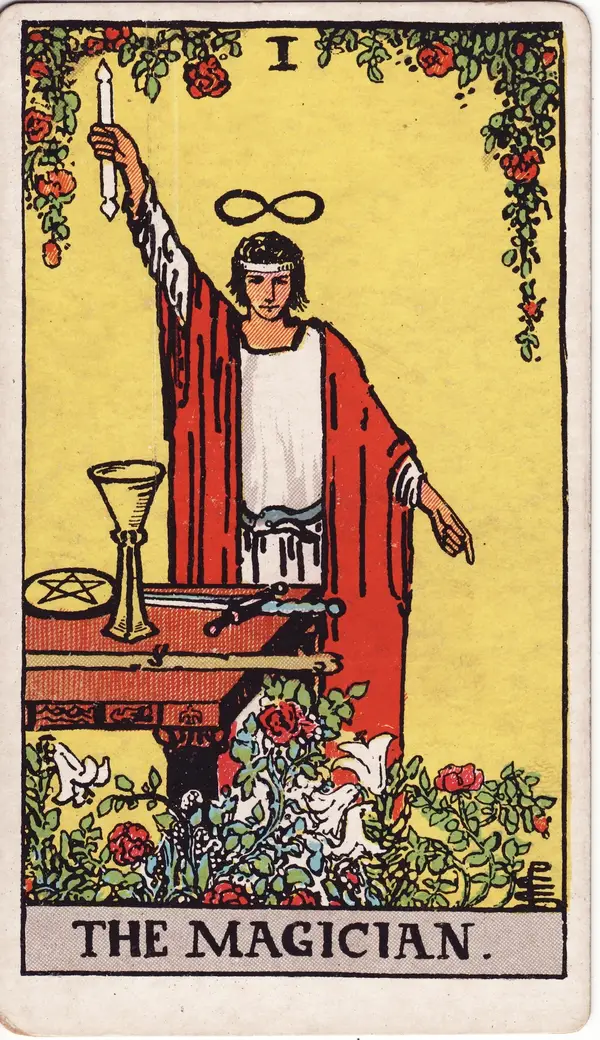
Le Bateleur in Jean Dodal's pack, and the Magician in 1909.
The Magician (Le Bateleur): Tarot de Marseille by Jean Dodal, Lyon, about 1701-1715, Jean Dodal. Public domain, via Wikimedia Commons.

From game to reading: Paris in the 1780s
In 1781 the scholar Antoine Court de Gébelin published the eighth volume of his book Le Monde primitif. In it he argued that the trumps were the remains of an ancient Egyptian book of wisdom, hidden in a card game so that it would survive. There was no evidence for this, and when Egyptian hieroglyphs were finally deciphered in the 1820s, nothing in them pointed to tarot. The idea spread anyway.
A Parisian card reader who called himself Etteilla (his surname, Alliette, written backwards) went further. Through the 1780s he published the first books on reading tarot cards for meaning, and he designed a deck for the purpose, with meanings printed on the cards and a different meaning for each card turned upside down. Readers have been arguing about reversed cards ever since.
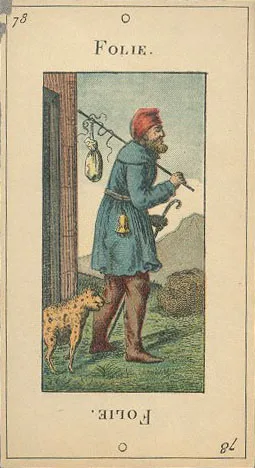
La Folie, the Fool, from a later printing of the Grand Etteilla, a deck made for reading rather than play.
La Folie (Folly): Grand Etteilla, a fortune-telling deck in the line Etteilla began in the 1780s, after Etteilla. Public domain, via Wikimedia Commons.

Occult tarot in the nineteenth century
In the 1850s the French writer Éliphas Lévi tied the twenty-two trumps to the twenty-two letters of the Hebrew alphabet and to the Kabbalah. In London, the Hermetic Order of the Golden Dawn, founded in 1888, built that into a full system. Every trump was matched with a Hebrew letter and with a planet, a star sign or an element, and every suit with an element. Most English-language tarot still follows that map.
The Golden Dawn also swapped two cards. Strength had been number eleven and Justice number eight; the order put Strength at eight and Justice at eleven so that the cards would follow the signs of the zodiac in sequence, Leo before Libra. The 1909 deck kept the swap, which is why some decks number those two cards one way and some the other.
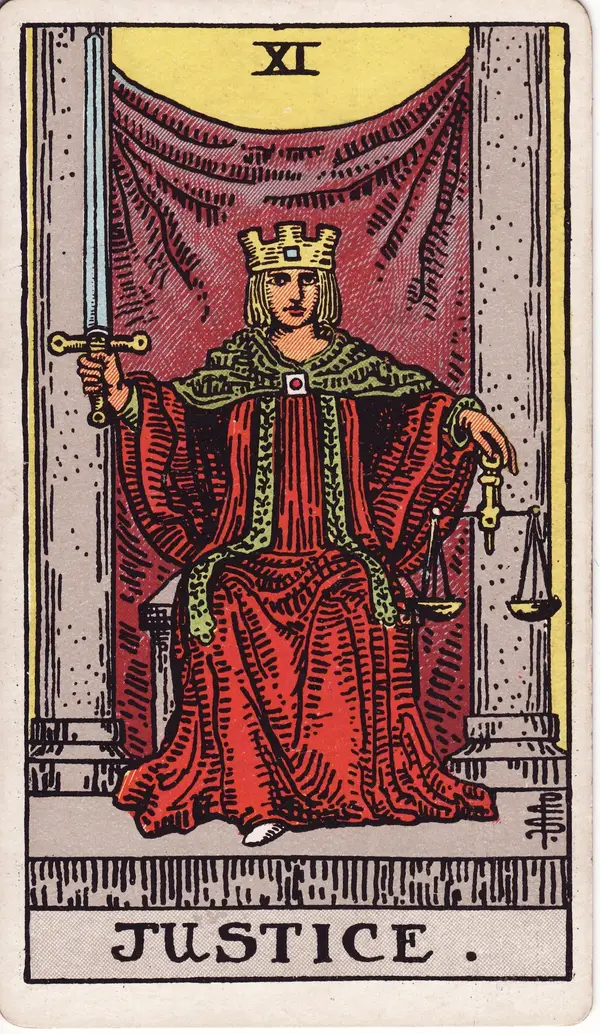
Strength as VIII and Justice as XI, the Golden Dawn order.
The 1909 deck
The deck used on this site was designed by Arthur Edward Waite, a member of the Golden Dawn, and drawn by the artist Pamela Colman Smith. It was published by William Rider and Son of London at the end of 1909, and it is often called the Rider-Waite or Rider-Waite-Smith deck.
Its great change was in the minor cards. Earlier packs usually showed the number cards as a pattern of suit symbols, five cups or eight coins and nothing else. Smith drew a scene for all fifty-six of them: a figure walking away from eight stacked cups, a man clutching his coins. Only one earlier deck, the Sola Busca pack from the late 1400s, had done anything like it, and Smith is thought to have seen photographs of it. Her scenes are why a beginner can look at a minor card and guess what it is about.
Smith was paid a flat fee and was given little credit in her lifetime. Her pictures went on to become the most copied tarot images in the world, and most modern decks are built on them.
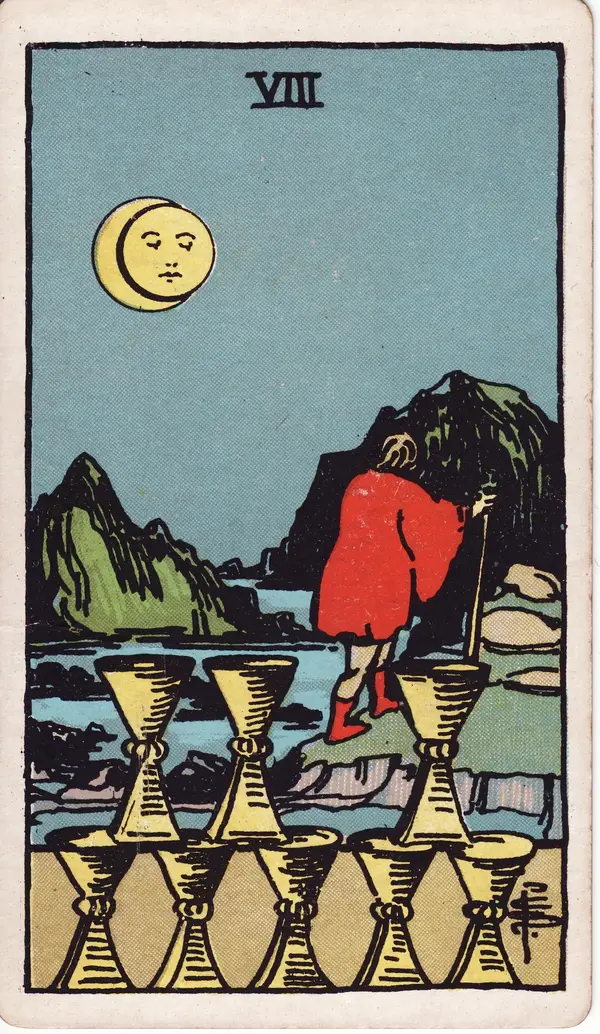
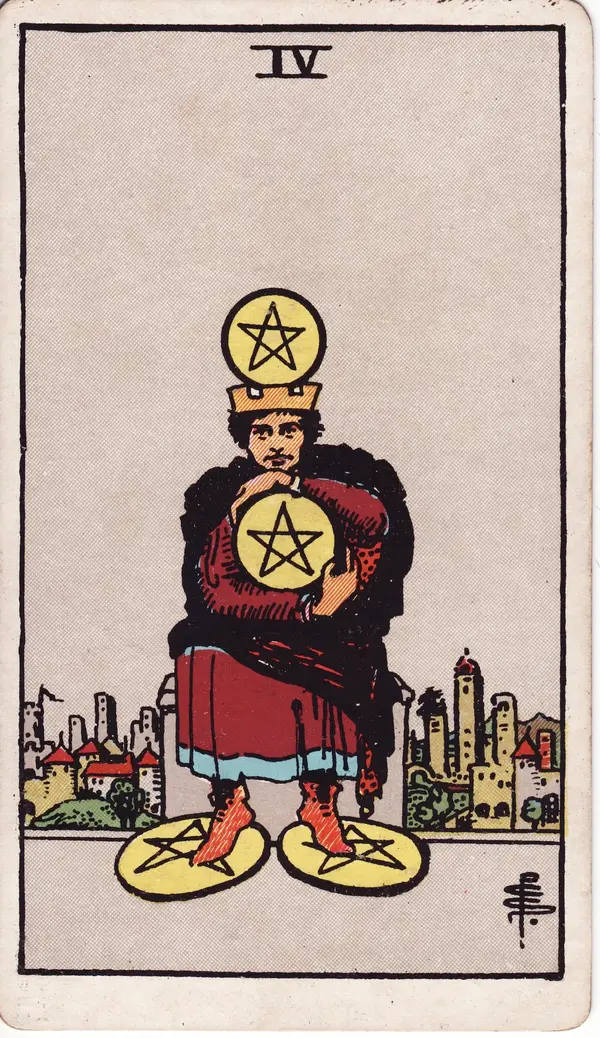
Two of Pamela Colman Smith's scenes for the minor cards.
What the history tells a reader
The cards were not made to predict anything. Their pictures came from Renaissance art, Christian symbolism and the courtly processions of fifteenth-century Italy, and the meanings were added much later by people who found the images rich enough to think with. That is how this site uses them: as a set of well-made pictures to reflect on, not a forecast.
See which three cards come up for you today, read for your star sign and the moon.
Get today’s readingRider–Waite–Smith, 1909 · art by Pamela Colman Smith